When Does a Government Chatbot Become an Operating Layer?
America.gov began as a conversational gateway to federal information. Its planned expansion into authenticated transactions could fundamentally change how Americans interact with government—and raise new questions about trust, authority, and accountability.
By Shreeya Aggarwal | October 21, 2026 | 6-minute read
Artificial Intelligence | Digital Government | Technology Policy
On September 29, 2026, the U.S. government launched America.gov, an AI-powered service intended to simplify access to federal information and services. Designed as a unified digital front door, the platform allows users to ask questions in everyday language rather than navigate thousands of government websites independently.
At launch, the chatbot could draw information from approximately 29,000 federal websites. But the government's ambitions extend beyond answering questions. Its executive order calls for authentication through Login.gov and integration with agency APIs, digital forms, and existing services, potentially enabling users to complete government transactions from one conversational interface.
That raises a more consequential question than whether the government has built a useful chatbot:
When does an AI assistant stop being an information tool and become part of the government's operating infrastructure?
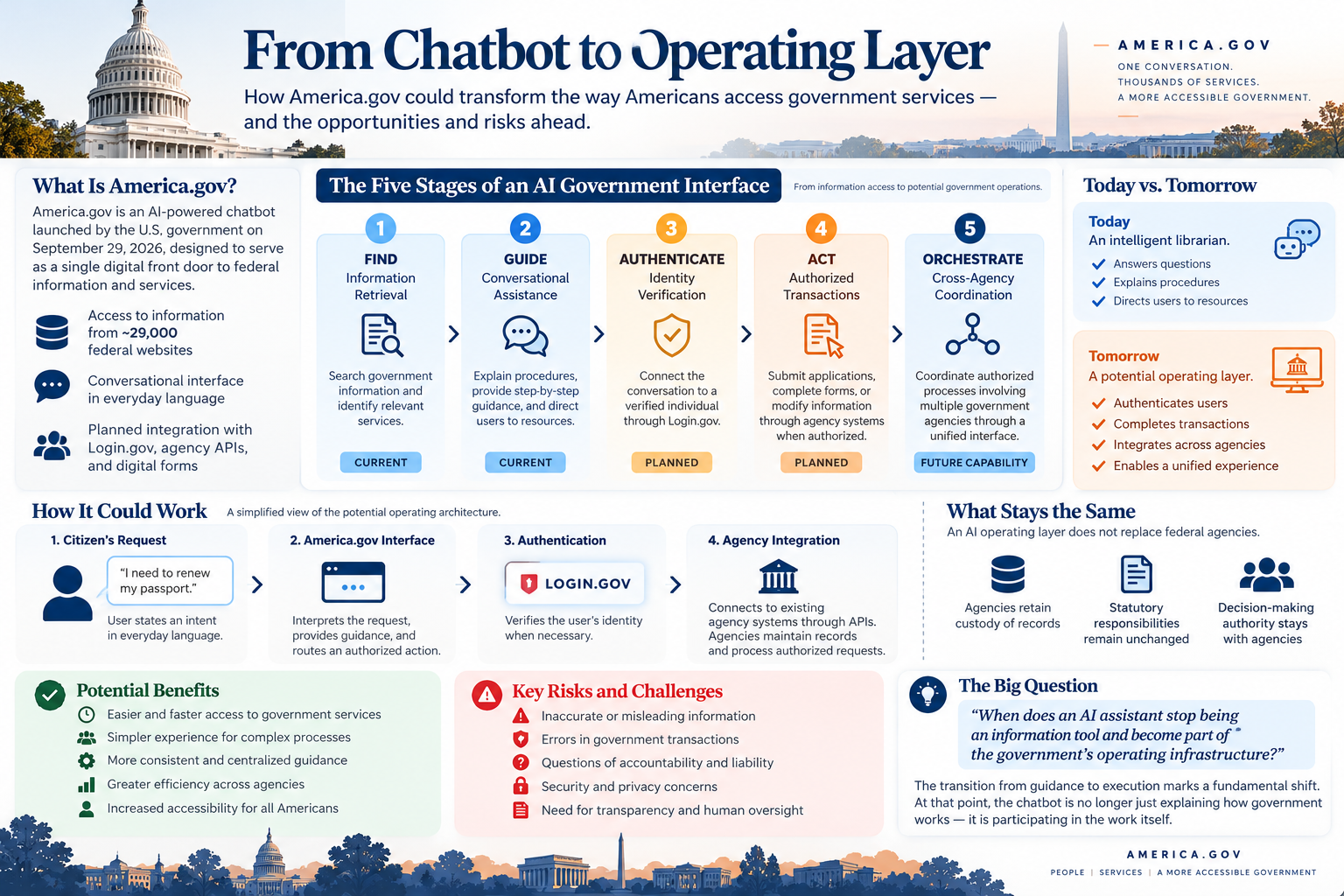
Figure 1. From Chatbot to Operating Layer: How America.gov could evolve from an AI-powered information assistant into a transactional government interface, including its potential architecture, benefits, and risks. The five-stage progression is a conceptual framework, not an official implementation timeline.
1. Today, America.gov Is Still Mostly a Librarian
America.gov currently functions primarily as an information and navigation service.
Rather than requiring users to identify the correct federal agency, locate its website, and interpret complicated terminology, the platform allows them to describe their needs conversationally.
The chatbot can surface relevant government information, explain procedures, and guide users toward appropriate resources.
However, independent testing by The Washington Post on October 1 found that the system could not yet complete the transactions demonstrated in the administration's promotional materials, including changes to personal records and other agency processes.
This distinction is essential.
A chatbot that explains how to renew a passport is providing guidance. A system that securely authenticates someone, submits an application, and receives confirmation from an agency is performing an operational function.
Today's America.gov is closer to an intelligent librarian than a federal operating layer.
2. The Real Threshold Is Authority
The transformation from chatbot to operating infrastructure is not primarily about language-model intelligence.
It is about the authority to perform actions within government systems.
Executive Order 14432 directs federal agencies to support America.gov through existing digital services, APIs, and forms, while establishing Login.gov as an authentication mechanism. These provisions create a policy foundation for future transactional capabilities, although they do not establish that every required integration is already operational.
A useful framework for understanding this evolution is:
The Five Stages of an AI Government Interface
1. FIND — Information Retrieval (Current)
Search government information and identify relevant services.
2. GUIDE — Conversational Assistance (Current)
Explain procedures, provide step-by-step guidance, and direct users to appropriate government resources.
3. AUTHENTICATE — Identity Verification (Planned)
Connect the conversation to a verified individual through Login.gov.
4. ACT — Authorized Transactions (Planned)
Submit applications, complete forms, or modify information through agency systems when authorized.
5. ORCHESTRATE — Cross-Agency Coordination (Potential Future Capability)
Coordinate authorized processes involving multiple government agencies through a unified interface.
This five-stage framework is an analytical interpretation, not an official government implementation schedule.
The first two stages involve finding and explaining information. Authentication connects a conversation to a verified individual. Acting introduces the ability to submit or modify information in an agency system with appropriate authorization.
Orchestration goes further: a single interface could coordinate an authorized process involving multiple agencies.
The decisive threshold is the transition from guidance to execution.
At that point, the system is no longer simply helping someone understand a process. It is participating in that process.
3. An Operating Layer Would Not Replace Federal Agencies
An AI operating layer does not necessarily mean replacing federal agencies with one centralized intelligence system.
In fact, the executive order explicitly preserves agencies' custody of records, statutory responsibilities, and decision-making authority. It also prohibits treating unified access as permission to create a centralized federal system of personal records.
The intended structure is closer to an interface connecting existing government services.
A Conceptual Operating Architecture
Step 1: Citizen's Request
A user states an intent, such as: "I need to renew my passport."
Step 2: America.gov Conversational Interface
The system interprets the request, identifies the relevant service, and provides guidance or routes an authorized action.
Step 3: Authentication and Agency Integration
Login.gov verifies the user's identity when necessary. Agency APIs connect the interface to existing services, while individual agencies maintain official records and process authorized requests.
This is a conceptual architecture based on the executive order, not a verified technical implementation.
This approach could fundamentally change the experience of accessing government services.
Today, citizens often have to understand the government's organizational structure before they can accomplish a task. They must identify the responsible agency, navigate its website, understand its terminology, and locate the correct process.
A more integrated system could reverse that relationship: the citizen states an intent, and the interface identifies which services need to respond.
The underlying agencies would retain their responsibilities, while the user would interact with a more unified digital experience.
4. Greater Capability Creates Greater Risk
The same capabilities that make America.gov more useful could make errors more consequential.
An incorrect explanation can mislead someone. An incorrect transaction can affect an application, delay access to services, or introduce errors into official records.
The difference is significant.
In September, TechCrunch highlighted the risks of inaccurate AI-generated information in sensitive government contexts, including benefits, immigration, and taxation.
As America.gov moves toward transactional functionality, several questions become central to its design:
Authorization: What specific actions can the system perform after authentication?
Consent: How will users review and approve consequential transactions?
Accountability: Who is responsible when the AI misunderstands a request?
Reversibility: Can incorrect submissions or changes be corrected?
Auditability: Will records clearly distinguish AI recommendations, user approvals, and agency actions?
These are not simply interface-design questions. They concern the reliability and accountability of government operations.
5. Predictability Matters as Much as Accuracy
America.gov has already demonstrated why consistent behavior matters.
In launch-week testing, Axios reported that the chatbot sometimes answered politically sensitive factual questions and sometimes refused them. Experts suggested several possible explanations, including differences in model behavior, system instructions, and caching, without establishing a definitive cause.
The issue extends beyond political content.
When an AI system represents an official government information channel, users need to understand how its responses are generated, when its behavior changes, and how to challenge potentially incorrect outputs.
These expectations become even more important when the platform begins interacting with authenticated personal information and agency systems.
An operating layer requires more than accurate source documents. It requires dependable behavior, clear boundaries of authority, transparent changes, and mechanisms for human oversight.
6. The Bigger Shift: From Information to Execution
America.gov is not yet a federal operating layer in the strongest sense.
Its currently demonstrated capabilities remain concentrated on information retrieval, explanation, and navigation. Its planned architecture, however, establishes a pathway toward something substantially more powerful.
The key milestone will not be the introduction of a smarter model or a more sophisticated conversational interface.
It will be the moment the platform can reliably authenticate a user, receive narrowly defined authorization, communicate with an agency system, and complete a permitted action with a verifiable record of what occurred.
That is when the role of the chatbot changes.
It stops merely explaining how government works—and begins participating in the work itself.
Sources and Further Reading
1. The White House — Executive Order 14432 (September 29, 2026)
Streamlining Access to Government Services Through America.gov
Primary source for the planned architecture, Login.gov integration, agency APIs, and preservation of agency authority.
2. The White House — America.gov Fact Sheet (September 29, 2026)
President Donald J. Trump Streamlines Access to Government Services Through America.gov
Official description of the platform's launch, objectives, and future capabilities.
3. The Washington Post — America.gov Hands-On Test (October 1, 2026)
Independent testing of the chatbot's capabilities and limitations shortly after launch.
Read the Washington Post Article
4. TechCrunch — Can a Chatbot Fix the Government Maze? (September 29, 2026)
Analysis of America.gov's launch and the risks associated with AI-generated government information.
5. Axios — America.gov's Conflicting Chatbot Answers (September 30, 2026)
Reporting on inconsistent chatbot responses and the challenges of predictable AI behavior.
6. America.gov — Official Documentation
Official platform documentation describing America.gov's intended functionality.
7. OpenAI — ChatGPT (GPT-6)
AI-assisted research, writing, editing, and infographic development (October 2026).
ChatGPT, powered by OpenAI's GPT-6 model, was used to assist with researching and structuring the article, refining its analysis, editing for clarity, and developing the accompanying infographics. The article's factual claims are supported by the primary government documents and independent reporting listed above.
AI Tools Used:
ChatGPT (OpenAI GPT-6): Research assistance, article drafting, analysis, editing, and formatting.
OpenAI Image Generation: Creation of the accompanying conceptual infographics. The exact underlying image-generation model version is not available in this conversation.
Provider: OpenAI
Website: https://chatgpt.com/
Date accessed: October 21, 2026
Published by SoCal AI Hub | University of California, Riverside
This article provides independent analysis of publicly documented government technology initiatives. The five-stage operating-layer framework is an analytical interpretation, not an official federal implementation model.