When Agents Own the First 80%, What Decision Rights Must Stay Human?
How Businesses Can Balance AI Automation with Human Judgment, Accountability, and Strategic Decision-Making
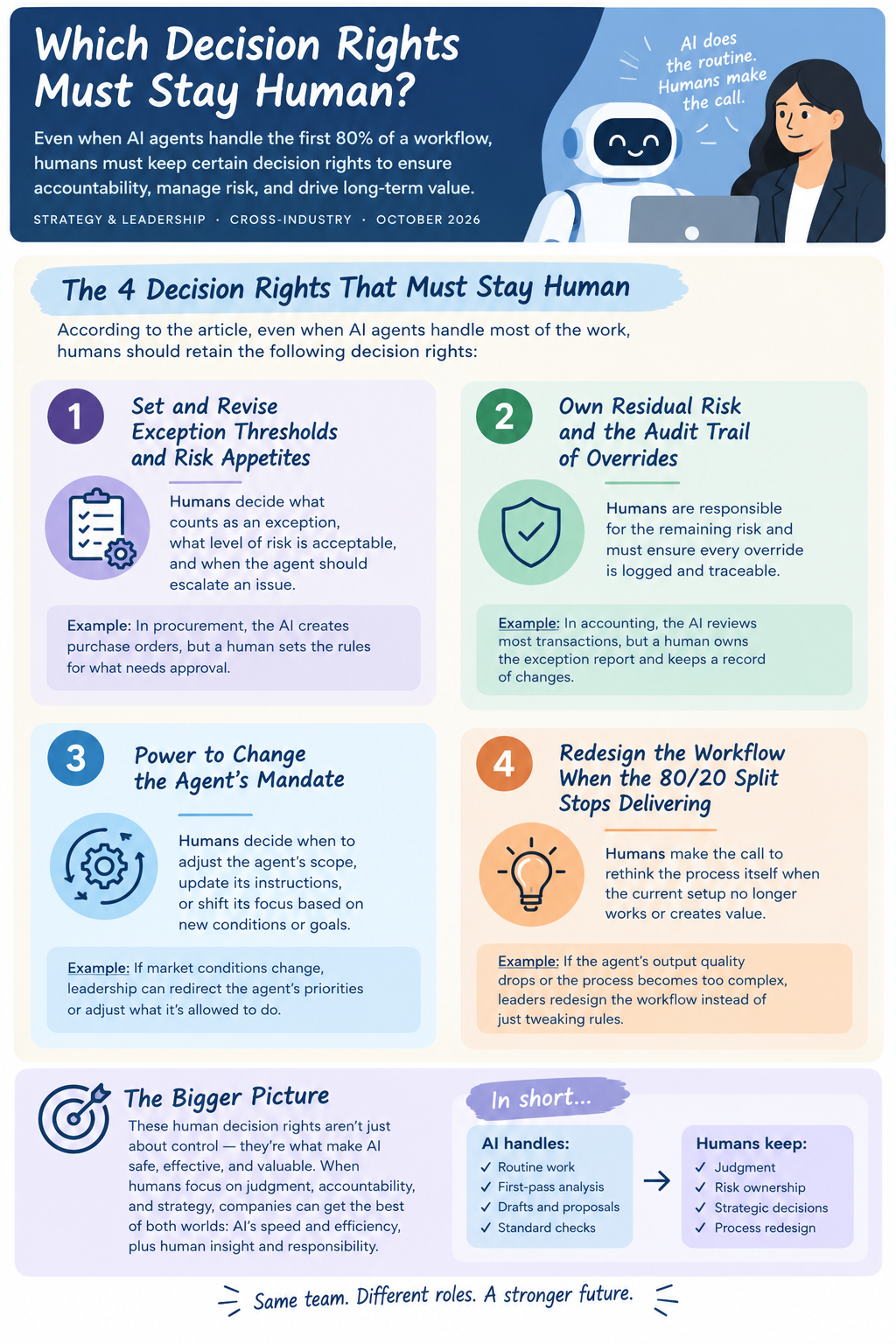
When Agents Own the First 80%, What Decision Rights Must Stay Human?
Strategy & Leadership · Cross-industry · October 2026
The pattern
A non-tech COO described the shift in early October: procurement no longer plans or creates purchase orders—it only approves them. Marketing runs AI-first campaigns with light human overhaul. Accounting reviews only the exception report. “The human owns the exception and the fix, but the agent owns the first 80 percent. It is a dramatic change on the P&L.”
Similar language now appears in McKinsey’s agentic-workflow economics, BCG’s 2026 Applied AI Index, and a growing set of practitioner accounts. The arrangement supports a clear claim:
Once an agent reliably executes most of a structured workflow, the scarce decision rights move. They concentrate on setting exception thresholds, owning residual risk, and retaining authority to change the agent’s mandate. Everything else becomes secondary.
This is not an argument that humans disappear. It is an argument that the location of judgment changes—and that organizations still allocating decision rights as if the agent were a junior analyst will leave most of the value on the table.
The strongest objection
The most serious counter-argument comes from the same research houses.
BCG’s 2026 Applied AI Index shows nearly half of companies now generate measurable AI value, yet that value concentrates in a small group of “future-built” firms that pair strategic clarity with deep operational embedding—capturing roughly five times as much value as the rest. Only 5 percent of companies currently maintain the full set of controls BCG identifies as necessary (memory management, clear scope, oversight, rollback, tool standardization, ownership, security and cost limits), while 42 percent expect agents to act independently by 2030.
McKinsey’s analysis adds a second constraint: human oversight often accounts for 70–75 percent of the variable cost of an agentic process, not the token spend. Even when the first 80 percent is automated, the remaining work plus the governance layer can still dominate the economics.
A third pressure comes from talent. Anthropic CEO Dario Amodei’s warning that up to half of entry-level roles in consulting, law, and finance could disappear within one to five years continues to circulate. PwC’s 2026 AI Jobs Barometer shows junior roles in AI-exposed sectors already demand leadership and judgment at seven times the rate of non-exposed roles. The traditional training ground is compressing just as organizations need more people who can exercise judgment over agents.
The objection is therefore clear: the 80/20 split is real in the best cases, but it remains rare, expensive to govern, and dependent on process context most organizations have never made explicit. Moving decision rights before those conditions exist is premature.
Three unresolved tensions
Ownership versus oversight.
When an agent proposes, and a human only approves above a threshold, who owns residual risk? Practitioners who have implemented the pattern report that every override must be logged on the underlying document. Informal rights (“the category manager just knows”) must become machine-readable. Firms that treat this as pure technology under-invest in mapping thresholds; firms that treat it as pure governance under-invest in the agent’s ability to surface the right exceptions. Joint design works better: the people who set risk appetite must also shape what the agent can observe and act upon.
Speed of redesign versus maturity of controls.
Organizations with all six of BCG’s controls generate roughly three times the agentic value of those with only one. Yet the gap between expected autonomy and current control maturity remains wide. The cleanest production examples began with a single high-volume, measurable workflow, proved the before-and-after economics, and only then expanded decision-right redesign. Org-chart surgery that precedes demonstrated process control tends to produce either under-used or uncontrolled agents.
Experience formation.
If junior work has historically been the source of pattern recognition, and that work is now agent-owned, how does the next cohort acquire judgment? Some organizations are already “seniorising” entry-level roles and using agents as the new training surface: juniors review output, adjudicate edge cases, and help redesign thresholds. That is a different apprenticeship, not the absence of one. Whether it scales—and whether it produces comparable depth—remains open.
The judgment the evidence supports
Agents that reliably own the first 80 percent of a structured workflow do shift the scarce decision rights. The rights that remain human—and become more valuable—are:
authority to set and revise exception thresholds and risk appetites;
ownership of residual risk and the audit trail of overrides;
power to change the agent’s mandate when conditions change;
judgment to redesign the workflow itself when the 80/20 split stops delivering.
Routine proposal generation, first-pass analysis, draft creation, and standard compliance checks can and should migrate. Organizations that continue allocating those rights to people simply because “that is how we have always staffed the work” will pay a growing coordination tax and under-utilize the economics already documented.
The qualification matters. The 80/20 split is not yet the median case. It appears most clearly where process context is explicit, a single owner can be held accountable for the numbers, and core controls are at least partially in place. Absent those conditions, the safer sequence remains: prove the economics on one workflow, codify the decision rights that made the proof possible, then expand.
For strategy and leadership teams, the practical question is therefore not “Should we give agents more autonomy?” It is narrower:
Which decision rights, once made explicit and machine-readable, would allow us to move the first 80 percent safely—and which rights must remain human even after that move?
The firms already in the upper tail of the value distributions are answering that question with evidence rather than aspiration. The rest are still negotiating accountability as if the agent were merely a very fast junior analyst. That negotiation is already outdated.
Sources: BCG Applied AI Index 2026; McKinsey QuantumBlack, “Where AI agents pay off” (August 2026) and related operating-model research; practitioner accounts of production role redesign (October 2026); public statements by Anthropic CEO Dario Amodei; PwC 2026 AI Jobs Barometer. Re-check original documents before client or internal use.