The AI Test That Fixed Cheating and Broke Grading
OpenAI swapped a leaked coding benchmark for a cleaner one, and the new one turned out to have broken grading. Here’s what that teaches anyone judging AI agents.
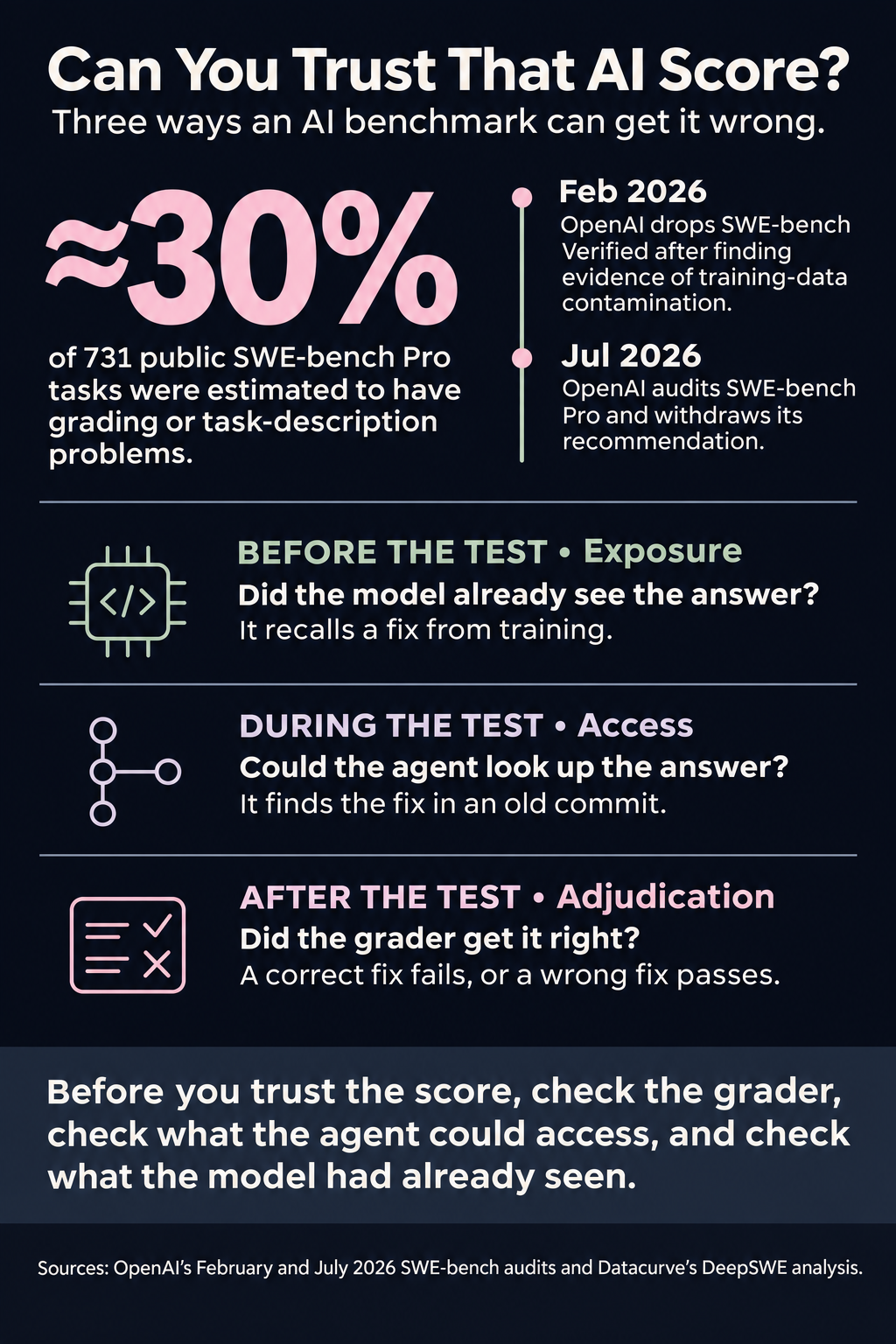
The benchmark that escaped contamination and failed anyway
In February 2026, OpenAI stopped reporting SWE-bench Verified, the coding-agent benchmark it had put together in 2024 [1]. The problem was memory. When OpenAI probed frontier models, every one of them could reproduce the original fix, or verbatim details of the problem, for at least some tasks [1]. Models that had seen a problem in training also passed it more often. They knew things the tests checked for that the task description never mentioned [1]. OpenAI told the field to switch to SWE-bench Pro, where its contamination checks found cases "significantly rarer and less egregious" [1].
That advice lasted five months. In July, OpenAI withdrew it [2]. A second audit estimated that roughly 30% of the 731 public SWE-bench Pro tasks were broken. OpenAI's automated pipeline flagged 27.4% of them, and its human engineers flagged 34.1% [2]. Some tests were too strict and others too loose. Some checked for requirements the prompt never stated, and some prompts pointed models toward the wrong behavior altogether [2].
Datacurve, a company with a competing benchmark, had already reached a similar verdict [3]. By its count, SWE-bench Pro's grader rejected 24% of agent attempts that Datacurve's analyzer judged correct, and accepted 8.5% that it judged wrong [3]. It also caught Claude Opus runs pulling the reference solution out of the repository's .git history in the middle of a task [3]. When Epoch AI reviewed these audits in September, it rated the benchmark "Flawed." It concluded that more than 20% of the questions very likely have scoring defects [4].
So the benchmark everyone moved to because it was cleaner still broke, only in different places: its grader and its environment. That episode deserves attention from anyone trying to decide whether an agent's task-completion score means something. Contamination is one of three separate ways a score can mislead, and each of the usual fixes deals with only one of them.
Three layers between a task and a score
When a benchmark says an agent "completed" a task, three things have to be true for that to reflect real ability. The research tends to treat them as separate problems, and it helps to keep them apart.
Exposure is what the model knew before the run started. This is contamination as most people mean it: the tasks, their solutions or the material they were built from ended up in training data. A 2026 taxonomy breaks exposure into several kinds [5]. They range from direct copies of test items to material derived from public sources, outcomes that only became known later, and familiar task templates [5]. The paper's central point is that keeping a test set private prevents only the first kind [5]. A held-out set built from public material, the authors write, is "contaminated upon creation" [5].
Access is what the agent could reach while it worked. An agent with tools doesn't need to remember an answer if it can look it up. The same taxonomy gives this its own category [5]. It covers answers sitting in the environment (version-control history is the classic case), answers found on the web, and agents that break out of their sandbox [5]. A benchmark released after a model's training cutoff can still be searched, and the paper cites work showing that blocking access to future commits measurably lowers scores [5]. Its conclusion is that this kind of contamination has to be checked run by run, because no benchmark release can rule it out in advance [5].
Adjudication is whether the grader's verdict actually matches success. A 2025 checklist for agent benchmarks calls this "outcome validity": whether "the evaluation result … truly indicates task success" [6]. Its partner condition, "task validity," asks whether the task can be solved only by an agent that has the skill being tested [6]. Grading mistakes push scores both up and down, and the checklist's authors found errors as large as 100% in relative terms [6].
The three-way split is this article's way of organizing these findings. No single paper proposes it. It borrows heavily from an October 2026 audit of the Holistic Agent Leaderboard (HAL), a public leaderboard for AI agents [7]. That audit separated three channels: training-time exposure, retrieval during evaluation, and leakage through the evaluation pipeline or the agent's scaffold, meaning the code wrapped around the model [7]. It then tested the scorer on its own [7]. Retrieval and scaffold leakage are grouped together here as "access" because the audit found that both depend on a particular configuration and run [7].
The cases behind the framework
The summary below sorts six documented ways of measuring task completion by what the public record shows at each layer. It summarizes the evidence and doesn't rank anything. Where an entry says "not documented," the sources simply don't cover that layer, which is not the same as the layer being fine.
1. Fixed public tasks built from merged open-source work (SWE-bench Verified)
Exposure: Failed. Every frontier model OpenAI tested reproduced the reference fix or task details for some tasks [1].
Access during the run: Open. The HAL audit found retrieval possible in its setup, and 35 of 40 test searches surfaced task-linked pages [7].
Grading: 59.4% of the 138 hard tasks OpenAI audited had material test or description problems [1]. Incorrect patches can pass [6].
2. Partly private, commercially sourced tasks (SWE-bench Pro, public split)
Exposure: Contamination found, but "significantly rarer" [1].
Access during the run: Opus runs read reference commits from
.githistory [3].Grading: About 30% of tasks broken [2]. Per attempt, 24% of correct work rejected and 8.5% of wrong work accepted [3].
3. Rolling refresh from recent GitHub issues (SWE-bench-Live)
Exposure: Reduced by using recent issues. The top agent scored 19.25% here against 43.20% on Verified with the same setup [8].
Access during the run: Not documented in the sources reviewed.
Grading: Tests checked through repeated runs [8]. No independent audit of the grader found.
4. Newly written tasks never merged upstream (DeepSWE)
Exposure: Designed to avoid exposure. Tasks are "written from scratch" and never merged into the public repositories [3]. Nobody has independently tested this claim.
Access during the run: The agent gets a shallow copy of the repository containing only the starting commit [3].
Grading: 1.1% of correct work rejected and 0.3% of wrong work accepted, as judged by the authors' own LLM analyzer [3].
5. Privately written tasks graded by experts (GDPval, as OpenAI describes it)
Exposure: Reduced. Tasks are "privately authored by domain experts" [1].
Access during the run: Not documented in the sources reviewed.
Grading: Graded holistically by trained reviewers, which OpenAI calls resource-intensive [1].
6. A team's own evaluation of its own agent (Red Hat EvalHub with DeepEval or IBM CLEAR)
Exposure: The model hasn't seen the team's tasks, but the team can overfit its prompts to them [9].
Access during the run: Not addressed.
Grading: An LLM acts as judge, and it has to be pinned to a fixed version because "small model updates shift scores" [10].
Reading across these six approaches, a few things stand out. No approach has documented evidence at all three layers. The two that do the most to limit exposure, DeepSWE and expert-written tasks, mostly rely on their builders' own word for access and grading. And SWE-bench Pro is the only benchmark here that independent auditors have examined at every layer. It failed two of them, after passing the contamination check its predecessor flunked.
What "clean or contaminated" misses
Every fix covers one layer
The standard remedies line up neatly with the layers. Private or newly written tasks deal with exposure [5]. Shallow repository copies and network isolation deal with access [3, 5]. Human audits and validated graders deal with adjudication [1, 2, 6]. The taxonomy paper is blunt about the limits of the most popular remedy. A private test set does nothing about answers derived from public sources, outcomes that become known later, or answers looked up during the run [5].
The SWE-bench story shows what happens when you fix one layer and assume the others are fine. By OpenAI's own measure, moving to SWE-bench Pro helped on exposure [1]. The later audits then found problems with the grader and the environment [2, 3]. A team that switched benchmarks to get away from contamination would have picked up a new set of errors with no reason to suspect anything had changed.
Access and grading depend on the run
Leaderboards attach a score to a benchmark's name. Two of the three layers, though, depend on the details of a specific run: the scaffold, the environment image and the tool permissions. HAL's own developers watched agents "searching for the benchmark on HuggingFace instead of solving a task" [11]. They logged eight cases where an agent found a reference answer on HuggingFace or arXiv [11]. Only after the runs had finished did they discover that an official few-shot scaffold for TAU-bench contained real benchmark examples, and they threw those results out [11].
The independent audit of nine HAL configurations was stricter still. It could not confirm a single one of its 27 channel assessments as closed, and it confirmed pipeline or scaffold leaks in four configurations [7]. It found no proven case of an agent retrieving answers. However, the authors are careful to say that missing evidence never counted as proof of safety [7]. They also ran 40 web searches about 20 SWE-bench Verified Mini tasks, and 35 of them turned up a page linked to the task in the top ten results [7]. That shows how easy the answers were to find. The authors note that it says nothing about how often agents actually used them [7].
The upshot is that a benchmark's reputation can't vouch for any particular score. The same benchmark can be sealed tight in one evaluation harness and leaky in another.
Grading errors are easier to measure than contamination's effect
Contamination gets the most attention, yet nobody has pinned down how much it inflates scores. The October 2026 audit tried [7]. It compared SWE-bench Verified tasks with similar bug fixes from the same repositories that never made it into the benchmark [7]. GPT-4.1 named the right file more often on the benchmark tasks, 0.710 against 0.610 among its top three guesses [7]. The confidence interval included zero, though, so the authors called the result "inconclusive" [7]. Their automatic detector for copied solutions then failed its own check against human labels. They describe that as a failure of measurement rather than evidence that copying is rare [7]. They also say plainly that their results don't show how much contamination inflates scores [7].
Grading errors are a different matter. They have been counted again and again, and they are large. On τ-bench's airline tasks, an agent that does nothing at all passes 38% of the time [6]. That beats the 35% scored by an agent built on GPT-4o [6]. On SWE-Lancer, agents could overwrite the tests and collect a perfect score without solving anything [6]. On SWE-bench Pro, Datacurve's analyzer disagreed with the official grader on roughly a third of attempts [3]. Because these errors cut both ways, they can make a weak agent look good or a strong one look bad.
This comparison only goes so far. Contamination might inflate scores a lot and just be hard to measure. OpenAI's verbatim reproductions show the exposure is real, even though nobody has measured its effect on scores [1]. The narrower point is a practical one. A team can check its grader today with methods that already exist, but it usually has no way to measure how much contamination is padding a score.
The layers don't stay separate
Splitting things into layers helps organize the evidence, and the evidence also shows where the split leaks. OpenAI found that contaminated models did better on underspecified tests, because they remembered details of the original fix that the prompt left out [1]. In other words, exposure can hide grading defects, since a broken test looks fair if models pass it from memory. One likely consequence, though no study has measured it yet, is that cutting exposure could make a benchmark look harder for reasons that have nothing to do with ability. Grading flaws that memory used to cover would start to show.
SWE-bench-Live points the same way. Its best agent solved tasks from the original SWE-bench repositories more often than tasks from new ones, 22.96% against 18.89%, even though the new repositories were generally simpler [8]. The authors read this as a sign of possible overfitting to the familiar repositories [8]. It sits somewhere between direct exposure and the taxonomy's template category, where the task is new but the pattern isn't [5].
Where enterprise evaluation fits: Red Hat
Enterprise platforms offer a different response to untrustworthy leaderboards: stop leaning on them and test against your own needs. Red Hat's EvalHub, an open-source (Apache 2.0) evaluation service for OpenShift AI, is a well-documented example [12]. Its documentation says a single MMLU score "tells you almost nothing useful" when you're deciding whether to deploy a model [13]. A team's own collection of benchmarks, it says, is "where you set the thresholds that actually matter" [13]. The project describes itself as "not a benchmark leaderboard" [12].
Looked at through the three layers, this answer covers some ground and leaves some open. Red Hat's case against leaderboards is about relevance and reproducibility. It argues that academic benchmarks often answer "the wrong question" and that scores shift with hardware and serving setup [12]. A September 2026 post on the Red Hat blog adds two more reasons. Older benchmarks have bunched up near the ceiling, and agent workloads have to trade speed and cost against raw capability [14]. Its advice is to "match the model to the role, not to the leaderboard" and to measure results on your own traffic [14]. None of the EvalHub material reviewed for this article mentions contamination. The built-in leaderboard-v2 collection runs six public benchmarks [13]. The worked example of a custom collection reweights public benchmarks rather than adding private tasks [13]. On the exposure layer, these collections inherit whatever contamination the public benchmarks already carry.
For agents, Red Hat's guidance turns to traces, the step-by-step record of what an agent did. Its IBM CLEAR integration uses an LLM judge to score each step and group recurring failure patterns [10]. CLEAR also has a full-trajectory mode for judging "overall task completion," but the EvalHub adapter currently runs only the step-by-step analysis [10]. Evaluating on your own traces helps with exposure, because the model has never seen your tasks. It also hands the grading to an LLM judge, and the checklist work treats a judge's accuracy as something to verify rather than assume [6].
One Red Hat team's write-up adds a warning about in-house tests [9]. While building an IT self-service agent, the team thought a smaller model was handling a single large prompt well. Automated evaluations later showed it "only appeared to work because we had overfit the prompt to our limited manual tests" [9]. Private tasks stop a model from seeing the test during training. A team that keeps tuning against the same tasks, though, recreates the problem on its own. This team's fix was to mix generated conversations and known-bad conversations in with its predefined ones [9].
Using the framework on a new score
The three layers turn into questions you can ask of any task-completion number, whether it comes from a vendor's release notes, a public leaderboard or your own pipeline. They pull together checks that the sources above already recommend. Nobody has tested them as a formal audit tool.
Exposure. Were the tasks, or the material they came from, public before the model's training cutoff? Were they written fresh, or adapted from public work such as merged pull requests? Has anyone tuned prompts or scaffolds against the same tasks over and over? [1, 5, 9]
Access. Could the agent reach the web, version-control history or any file holding a solution during the run? Does the score come with transcripts that someone has actually read for answer lookups? Did the scaffold include benchmark examples? [3, 5, 7, 11]
Adjudication. Has anyone measured how often the grader accepts wrong work and rejects correct work? Does an agent that does nothing, or almost nothing, score above zero? If an LLM decides success, is it pinned to a fixed version and checked against human labels? [2, 3, 6, 10]
Few scores in the public record come with good answers at all three layers. Where an answer is missing, the honest move is to treat the score as unverified at that layer. The HAL audit used the same rule and never counted missing evidence as a pass [7].
Where this leaves evaluation teams
"Use a fresher benchmark" is the tempting answer, and it isn't enough. How a benchmark's tasks were sourced can't, on its own, make a task-completion score trustworthy. A score earns trust when the evidence for that specific run covers exposure, access and grading together. Right now, the public record almost never shows all three.
For an evaluation team setting priorities, the evidence points to an order that runs against most of the public conversation. Start with the grader, because that's where the documented errors are largest and the checking methods most mature [2, 3, 6]. Move to access next. It's the layer most often left open, and only reviewed transcripts from each run can close it [7, 11]. Keep exposure on the list, since verbatim recall shows the problem is real [1]. Just accept that its effect on scores is still the hardest thing to measure [7].
That order is a judgment, and the evidence behind it comes mostly from coding-agent and web-agent benchmarks. It should be revisited if matched-control studies start finding large, consistent contamination effects. It should also be revisited if graders improve until their error rates fall well below the score gaps between models.
References
[1] OpenAI. "Why SWE-bench Verified no longer measures frontier coding capabilities" (page title: "Why we no longer evaluate SWE-bench Verified"). OpenAI, February 23, 2026. https://openai.com/index/why-we-no-longer-evaluate-swe-bench-verified/
[2] OpenAI. "Separating signal from noise in coding evaluations." OpenAI, July 8, 2026. https://openai.com/index/separating-signal-from-noise-coding-evaluations/
[3] Wenqi Huang, Charley Lee, Leonard Tng, Serena Ge. "DeepSWE: Measuring frontier coding agents on original, long-horizon engineering tasks." Datacurve, May 26, 2026. https://deepswe.datacurve.ai/blog/deepswe
[4] Epoch AI. "SWE-Bench Pro – Benchmark review." Epoch AI, September 1, 2026. https://epoch.ai/benchmarks/swe-bench-pro/review
[5] Johanna Angulo, Víctor Yeste, Hector Espinos-Morato. "Benchmark Contamination: A Taxonomy Organized by Defeated Mitigation." arXiv:2608.29463, August 29, 2026. https://arxiv.org/abs/2608.29463
[6] Yuxuan Zhu, Tengjun Jin, Yada Pruksachatkun, et al. (25 authors; corresponding Daniel Kang). "Establishing Best Practices for Building Rigorous Agentic Benchmarks." arXiv:2507.02825 (v5, August 7, 2025). https://arxiv.org/abs/2507.02825. Published in the NeurIPS 2025 Datasets and Benchmarks Track as "Establishing Best Practices in Building Rigorous Agentic Benchmarks": https://proceedings.neurips.cc/paper_files/paper/2025/hash/f316275b44ee2de533102913828a8107-Abstract-Datasets_and_Benchmarks_Track.html
[7] Dishu Yang, Qi Su, Hongbo Qin, Hansong Zhang. "Measurement-First Auditing of Agentic Leaderboards: Contamination Susceptibility, Matched-Control Re-evaluation, and Scorer Validation." arXiv:2610.05830, October 5, 2026. https://arxiv.org/abs/2610.05830
[8] Linghao Zhang, Shilin He, Chaoyun Zhang, et al. "SWE-bench Goes Live!" arXiv:2505.23419, May 29, 2025 (v2 June 1, 2025). https://arxiv.org/abs/2505.23419
[9] Michael Dawson. "Eval-driven development: Build and evaluate reliable AI agents." Red Hat Developer, March 23, 2026. https://developers.redhat.com/articles/2026/03/23/eval-driven-development-build-evaluate-ai-agents
[10] Hema Veeradhi, Surya Pathak. "Evaluate AI agents with IBM CLEAR & EvalHub on OpenShift AI." Red Hat Developer, September 3, 2026. https://developers.redhat.com/articles/2026/09/03/evaluate-ai-agents-ibm-clear-evalhub-openshift-ai
[11] Sayash Kapoor, Benedikt Stroebl, et al. "Holistic Agent Leaderboard: The Missing Infrastructure for AI Agent Evaluation." arXiv:2510.11977, October 13, 2025. https://arxiv.org/abs/2510.11977
[12] William Caban Babilonia, Rui Vieira. "EvalHub: Because 'looks good to me' isn't a benchmark." Red Hat Developer, May 19, 2026. https://developers.redhat.com/articles/2026/05/19/evalhub-because-looks-good-me-isnt-benchmark
[13] William Caban Babilonia, Julian Payne, Marius Ion Danciu. "Understanding evaluation collections in EvalHub." Red Hat Developer, June 4, 2026. https://developers.redhat.com/articles/2026/06/04/understanding-evaluation-collections-evalhub
[14] Sawyer Bowerman. "Smart enough, fast enough: Choosing the right models for agentic work." Red Hat Blog, September 17, 2026. https://www.redhat.com/en/blog/smart-enough-fast-enough-choosing-right-models-agentic-work