Digital Employees, Real Liability: Why the “Malpractice Trap” for SaaS Vendors Is Really About Misrepresentation and Insurance
Calling AI agents “digital employees” probably won’t create malpractice liability for vendors, but it weakens their defenses and can leave their insurance coverage with gaps.
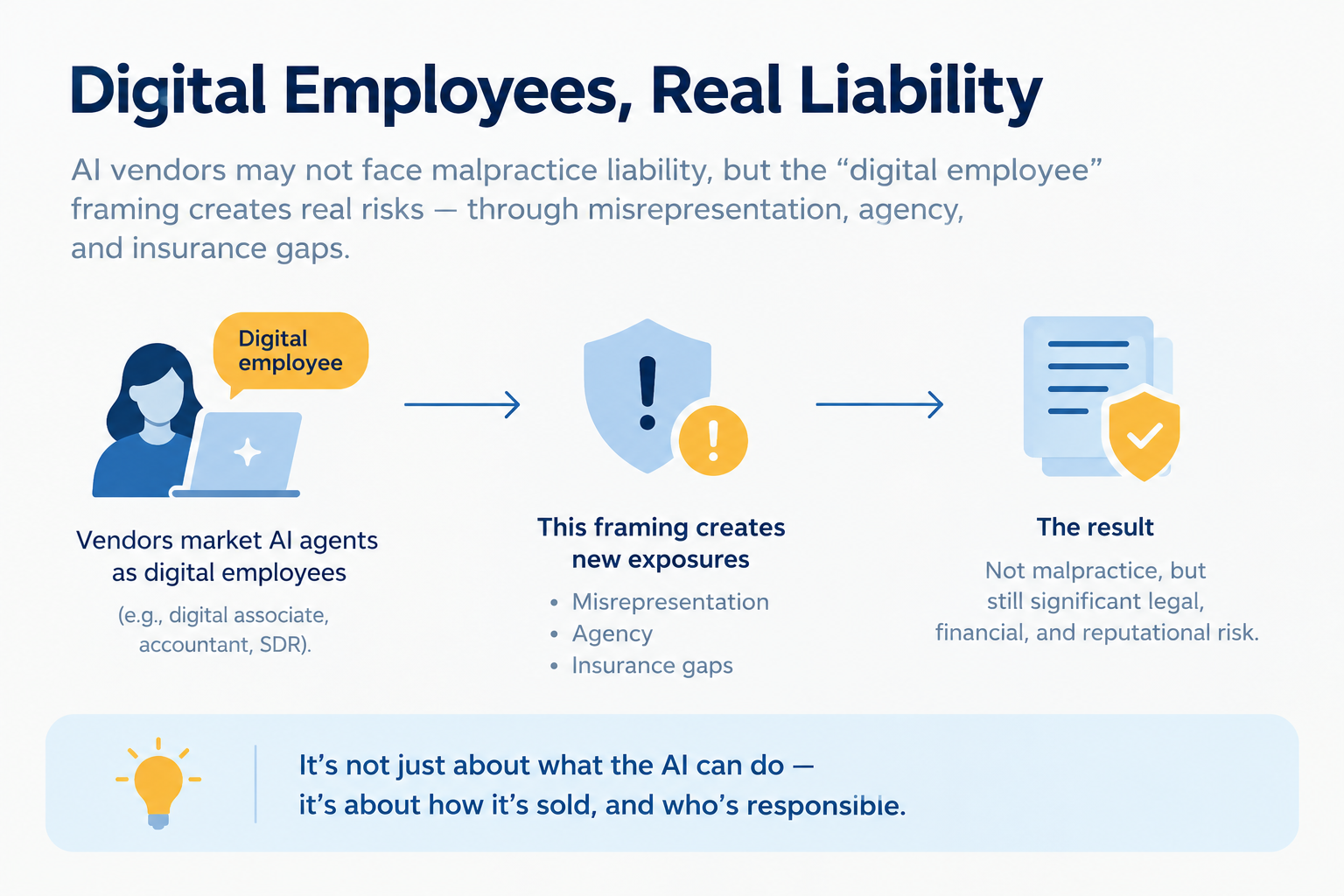
Digital Employees, Real Liability: Why the "Malpractice Trap" for SaaS Vendors Is Really About Misrepresentation and Insurance
Revised October 21, 2026 · General information, not legal advice
AI vendors increasingly sell agents as "digital employees": a digital associate, a digital accountant, a digital SDR. The pitch promises labor substitution at software margins. The legal question is whether that framing exposes vendors to malpractice-style liability. On the current authorities, strict malpractice liability for vendors is unlikely. The framing still matters, because it undercuts the defenses vendors normally rely on, and the resulting exposures (misrepresentation, agency, and insurance gaps) are arguably more dangerous than malpractice itself.
1. Malpractice binds the professional, not the tool
The strongest argument against a vendor malpractice theory comes from legal ethics. ABA Formal Opinion 512, issued July 29, 2024, creates no new rules and applies existing Model Rules to generative AI, including competence, confidentiality, communication, candor, supervision (Rules 5.1 and 5.3), and fees [7]. Its practical message is that lawyers cannot leave legal advice, claim negotiation, or other judgment-dependent functions to AI tools alone [8]. One commentary notes that the supervision rules may eventually raise hard questions about how human-level AI must be supervised, and that the aim for now is to keep AI from replacing the lawyer as the final decision-maker [9].
The first loss therefore lands on the customer. A law firm that treats an agent as a substitute associate carries the disciplinary and malpractice risk, because its duty of supervision is not delegable. A vendor selling that same agent as a replacement for the associate is pitching something the customer's own professional obligations forbid.
2. The vendor's exposure is derivative and runs through four channels
Agency law
In Mobley v. Workday, Judge Rita Lin of the Northern District of California allowed a theory that an AI vendor could be directly liable for employment discrimination as an "agent" of the employer. The reasoning was that the complaint plausibly alleged employers had delegated the traditional function of rejecting or advancing candidates [1][2]. The court rejected the separate "employment agency" theory [1]. The ruling is narrow: it concerns federal anti-discrimination statutes and was decided at the motion-to-dismiss stage, and one commentator describes a merits ruling as plausible but not yet delivered [3]. Even so, the logic is easier to invoke against a vendor that markets its product as a worker performing a delegated function.
Attribution of statements
In Moffatt v. Air Canada, 2024 BCCRT 149, the British Columbia Civil Resolution Tribunal rejected the airline's argument that it was not liable for what its chatbot said. It held that the company remained responsible for all information on its website, whether from a static page or a chatbot [5][6]. The tribunal also did not accept the premise that the chatbot was a separate legal entity responsible for its own actions [4]. This is a Canadian tribunal decision, so it is persuasive at most outside that setting. It still shows how readily an "it's a separate actor" defense fails, and a "digital employee" label invites the same attribution.
Advertising and consumer protection
The FTC's DoNotPay matter is the closest analogue to a "digital professional" pitch. DoNotPay marketed itself as "the world's first robot lawyer," and the FTC found it had not tested whether its chatbot performed at the level of a human lawyer. The final order bars claims comparing the service to human lawyers unless backed by substantial evidence [10]. Any "equivalent to a human accountant" claim needs the same substantiation.
Insurance
This is the sharpest exposure, and it matches the practitioner concern in the source items reviewed alongside this article. The market is leaving the "silent AI" era, and insurers are replacing implicit coverage under cyber and tech E&O policies with AI-specific exclusions or affirmative grants [13]. Willis research reported that the professional liability market shifted structurally between January 2025 and January 2026, moving from silent AI assumptions to either explicit affirmative warranties or absolute exclusions [11]. Another source says professional liability and E&O are seeing the most aggressive exclusion activity [12]. The same reporting notes that agents differ from chatbots because they carry out tasks rather than only generate responses, so failures could trigger claims across professional negligence, data breach, fraud, discrimination, and cyber lines [11].
A vendor that sells labor substitution while buying software-style coverage can end up with a gap: it is priced and valued as software, but its claims look like professional-services claims, and its policy may exclude them.
3. The counterargument
The "malpractice trap" label overstates the risk in several ways.
No professional, no malpractice. The ethics framework binds licensed lawyers [7]. A software vendor is not one, and no authority reviewed here holds a vendor to a professional standard of care because of its marketing.
Existing doctrines already cover most of this. Misrepresentation, warranty, agency, and consumer protection do the work, and the "digital employee" label adds aggravation without creating a new tort.
Insurance is moving in both directions. Some carriers are adding affirmative AI wording to technology E&O, professional liability, and cyber policies [11], and standalone products exist, such as an AI liability product HSB (a Munich Re company) launched in March 2026 [14]. The picture is fragmented, not uniformly closed.
Coverage varies by form. One broker-side source says most in-force E&O policies do not yet contain a specific AI exclusion [15], so the answer depends on the policy and the renewal date.
4. Practical takeaways for vendors
Align marketing with contracts. If sales says "digital associate" while the terms of service say "software tool, no professional advice," the gap itself becomes evidence of misrepresentation.
Substantiate any equivalence claim before making it, in line with the FTC's approach in the DoNotPay order [10].
In regulated verticals, sell supervised leverage rather than substitution. The customer's duty of supervision cannot be delegated [8], so a pitch that implies otherwise puts the customer at odds with its own obligations.
Audit coverage at renewal. Ask the broker specifically about AI exclusions in E&O, professional liability, and cyber, and whether agent actions are treated as covered products or services.
Keep audit logs and human-override points. They help on causation and on showing reasonable care.
Evidence notes
The practitioner posts reviewed alongside this article (Patrick Barone and @bgvc123) are opinion signals, not authority, and were not relied on for legal claims. The ABA material supports the supervision point independently.
Several insurance sources are trade press or broker and vendor blogs, and one disclosed that its co-author sells an AI product. Treat the market-trend claims as directional and verify them against current policy forms and filings.
Moffatt is a Canadian tribunal decision, and Mobley is a pre-merits ruling under federal employment statutes. Neither is a general rule for AI vendors.
Most sources are secondary summaries. For anything you rely on, check the primary documents (the ABA opinion text, the tribunal decision, the FTC order, and actual policy language).
A source previously cited for the precedential weight of Moffatt has been removed from this version, and the claim it supported has been dropped.
Sources
Seyfarth Shaw, "Mobley v. Workday: Court Holds AI Service Providers Could Be Directly Liable for Employment Discrimination Under 'Agent' Theory." https://seyfarth.com/news-insights/mobley-v-workday-court-holds-ai-service-providers-could-be-directly-liable-for-employment-discrimination-under-agent-theory.html
Law and the Workplace, commentary on Mobley v. Workday. https://www.lawandtheworkplace.com/?p=10565
Employment & Labor Law blog, "Mobley v. Workday: The AI Vendor as AI Agent." https://hh-law.com/blogs/employment-labor-law/mobley-v-workday-the-ai-vendor-as-ai-agent-creating-potential-new-liabilities/
McCarthy Tétrault, "Air Canada: A Misrepresentation by an AI Chatbot." https://www.mccarthy.ca/en/insights/blogs/techlex/moffatt-v-air-canada-misrepresentation-ai-chatbot
DWW, "BC Tribunal Finds Air Canada Liable for Inaccurate Advice Given by Website Chatbot." https://www.dww.com/articles/bc-tribunal-finds-air-canada-liable-for-inaccurate-advice-given-by-website-chatbot
Torkin Manes, "BC Tribunal Confirms Companies Remain Liable for Information Provided by AI Chatbot." https://www.torkin.com/insights/publication/bc-tribunal-confirms-companies-remain-liable-for-ai-chatbot-created-information
Vaquill, "ABA Formal Opinion 512: Generative AI Lawyers Guide." https://www.vaquill.ai/blog/aba-formal-opinion-512-generative-ai-lawyers-guide
South Carolina Lawyer, Ethics Watch (Sept. 2024), on ABA Formal Op. 512. https://mydigitalpublication.com/article/Ethics+Watch/4847103/829946/article.html
Business Law Today, "AI and Attorney-Client Privilege: A Brave New World for Lawyers." https://businesslawtoday.org/?p=27160
CO/AI, "FTC bans DoNotPay's 'AI lawyer' claims and orders refunds." https://getcoai.com/news/ftc-bans-donotpays-ai-lawyer-claims-and-orders-refunds
Insurance Business, "Insurers face hidden AI liability as agent risks multiply." https://www.insurancebusinessmag.com/us/news/cyber/insurers-face-hidden-ai-liability-as-agent-risks-multiply-582433.aspx
Zywave, "How AI is creating new commercial insurance coverage gaps." (July 27, 2026) https://www.zywave.com/blog/how-ai-is-creating-new-commercial-insurance-coverage-gaps-and-what-businesses-need-to-know/
Fenwick, "The End of 'Silent AI'? Emerging AI Exclusions, Coverage Fragmentation, and Practical Implications for Policyholders." https://fenwick.com/insights/publications/end-silent-ai-emerging-ai-exclusions-coverage-fragmentation-and-practical-implications
Beancount.io, "AI agent liability insurance gap: small business guide." (July 19, 2026) https://beancount.io/blog/2026/07/19/ai-agent-liability-insurance-gap-small-business-guide
Risk Specialty Group via MarketersMedia, "E&O Coverage and AI Design Work: What Firms Need to Know in 2026." https://stocks.observer-reporter.com/observerreporter/article/marketersmedia-2026-5-7-e-and-o-coverage-and-ai-design-work-what-firms-need-to-know-in-2026