An AI Disclosure Label Is Not an Audit Trail
What media buyers and accountants need to verify AI-generated advertising, from creative approval to final payment.
By Suhani Chheda | 7 min read | October 22, 2026
An AI-generated advertisement can reach a large audience while revealing remarkably little about how it was made. A synthetic image may appear without a consumer-facing AI label. A video may be edited, exported, and redistributed after its provenance metadata has disappeared. Meanwhile, the media buyer may retain invoices and campaign totals without a reliable connection between a specific creative version and the impressions purchased for it.
These are related problems, but they are not identical. A consumer disclosure communicates something about content. A provenance record documents assertions about its origin or modification. A financial audit attempts to verify transactions and balances. Forensic auditability requires those records to connect. None can stand in for the others.
Disclosure Is Not Proof of Compliance
In August 2026, the Interactive Advertising Bureau (IAB) published an updated AI Transparency and Disclosure Framework, advocating targeted disclosure when AI materially affects authenticity, identity, or representation in potentially misleading ways [1]. Its approach does not require an AI label for every AI-assisted production step. That distinction matters: absence of a label alone cannot establish that an advertiser violated the framework.
Nor does the presence of a label establish that the content is trustworthy. An advertiser can disclose AI involvement while still making an unsupported product claim or presenting a misleading endorsement. The US Federal Trade Commission's endorsement guidance requires truthful, nonmisleading representations and appropriate substantiation [2]. An AI label does not replace those obligations.
Disclosure can also create incentives that complicate voluntary compliance. A 2025 advertising experiment with 304 participants found that AI disclosure increased persuasion knowledge and produced competing effects on trust, including a negative pathway [3]. Three experiments published in the Journal of Retailing and Consumer Services likewise found that AI disclosures could reduce trust and ad attitudes in service advertising, with important differences depending on the attributes depicted [4]. These experiments do not show how often advertisers conceal AI use, and consumer responses cannot establish an audit failure. They do help explain why a label is a contested marketing decision rather than a complete forensic record.
Digital Provenance Has Its Limits
The Coalition for Content Provenance and Authenticity (C2PA) specifies a way to attach cryptographically verifiable provenance assertions to digital assets [5]. Such assertions can help identify the declared history of a media file and detect certain alterations. They are valuable when a buyer needs to establish which version of an asset was received or approved.
The specification's own explainer acknowledges that provenance metadata can be removed. It describes durable Content Credentials using mechanisms such as fingerprinting or watermarking to recover associations with externally stored records [6]. Therefore, the distributed file is not a guaranteed repository of its complete history. A missing credential is not proof that the asset was human-made, and a valid credential is not proof that every underlying claim is true.
This yields a practical distinction: cryptographic integrity can strengthen confidence that a record has not been altered, but the accuracy and completeness of the original assertion still depend on who supplied it and what was captured. An accountant examining an advertising expense also needs evidence that the approved asset was actually delivered and that the associated charges correspond to the contracted activity. Content provenance alone does not answer those questions.
Advertising's Financial Transparency Problem Started Before AI
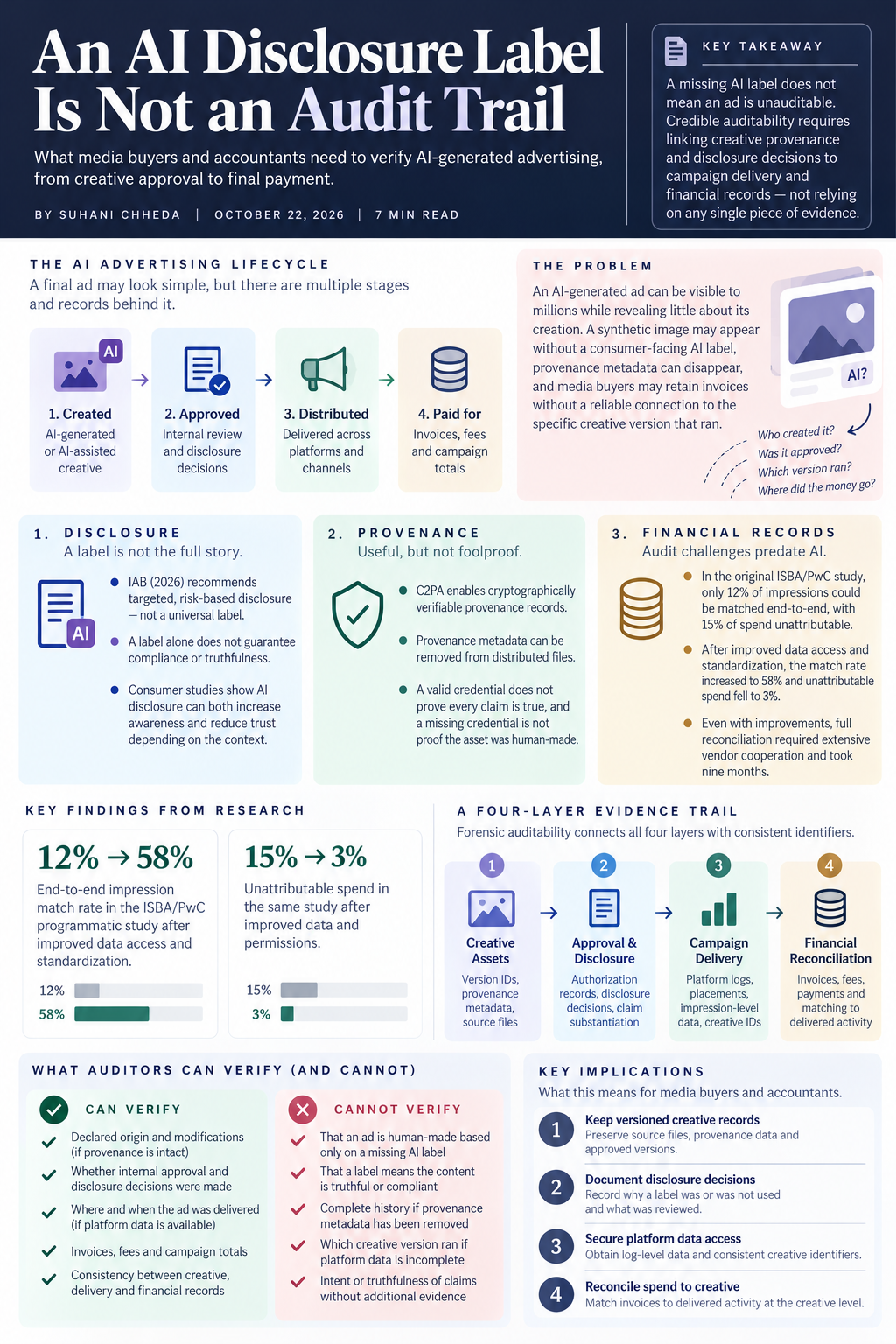
A particularly useful comparison comes from the UK programmatic advertising supply chain. According to ISBA’s reporting on its programmatic transparency research, the original study matched 12% of relevant impressions end-to-end and identified 15% of spend as unattributable [7]. The follow-up reported a 58% match rate and 3% unattributable spend [8]. These figures come from specific study samples and should not be treated as industry-wide rates or as measurements of AI-generated advertising.
The improvement matters because it shows what changed the quality of evidence: better access to log-level data, more standardized fields, and coordinated permissions across participants [8]. The cross-industry Programmatic Financial Audit Toolkit included an Audit Permission Letter and a Data Fields List intended to support impression-level reconciliation [7]. Even with those improvements, the later study required extensive cooperation from technology vendors and took nine months to complete [8].
Generative AI introduces a creative-history question into this already difficult transaction-reconstruction problem. A buyer may know the campaign budget, invoice, and publisher but not whether the delivered asset was the authorized version or whether a synthetic spokesperson had been approved. Conversely, a detailed creative provenance record can exist without sufficient transaction data to establish which impressions carried that asset. The evidence supports treating these as complementary, not interchangeable, records.
The Four Layers of a Verifiable AI Advertising Campaign
The evidence points toward four connected layers of documentation. This is a proposed audit model derived from the cited research and standards, not an independently validated industry-wide requirement.
Evidence LayerCore Audit QuestionIllustrative RecordWhat It Cannot Establish AloneCreative provenanceWhich asset and declared production history?Version identifier, preserved original, signed provenance assertions where availableTruth of claims or authorizationApproval and disclosureWho approved this version and why was a label used or omitted?Approval timestamp, approver, disclosure assessment, claim substantiationActual deliveryCampaign deliveryWhere and when did that approved version run?Creative ID, campaign ID, placement and impression-level logsComplete financial settlementFinancial reconciliationWhat was purchased, charged, and paid?Contracts, invoices, platform logs, payment and ledger recordsAuthenticity of the creative
The central control is a durable linkage among identifiers. A creative version identifier should connect to its approval record, its campaign delivery identifier, and the charges attributed to that delivery. If one platform replaces or renames identifiers, the buyer needs a preserved mapping; otherwise, the chain may break even when each participant retains its own data.
There are trade-offs. Preserving every generation prompt, intermediate asset, and platform event may increase storage, privacy, confidentiality, and vendor-access burdens. Preserving only final exports and invoices reduces burden but may prevent investigation of a disputed synthetic endorsement or unauthorized substitution. The appropriate depth of retention should therefore depend on the risk of the claim, the sensitivity of the depicted person or event, contractual access, and applicable recordkeeping duties. These are proposed risk criteria, not an empirical ranking established by the studies.
Accountants should distinguish between an audit of financial-statement assertions and a broader forensic investigation. The former may focus on occurrence, completeness, accuracy, cutoff, and classification of advertising expenditure. The latter may additionally examine identity, authorization, content manipulation, disclosure decisions, and vendor conduct. Neither engagement automatically provides assurance over every dimension of the other.
Why AI Labels and Traditional Audits Aren't Enough
The first tempting answer is to require universal AI labeling. Labels may provide useful information to consumers, but the IAB framework intentionally differentiates high-risk representations from routine AI assistance [1]. More importantly, labels do not create missing financial records or prove that a particular approved creative was delivered. Universal labeling could alter disclosure coverage without resolving transaction auditability.
The second tempting answer is to rely on established financial controls. The ISBA/PwC studies show that these controls already face serious cross-platform matching and access difficulties [7, 8]. Even successful reconciliation of payments and impressions would not independently establish that a synthetic person's appearance was authorized or that an advertiser preserved the version approved by its legal team.
A third possibility is that platforms will make the problem largely disappear through native provenance and reporting. The C2PA standard demonstrates that meaningful provenance technology exists [5], but metadata removal and incomplete coverage remain relevant limitations [6]. There is insufficient public end-to-end evidence to conclude that platform integrations routinely connect AI creation, disclosure approval, delivery, and settlement across vendors.
What True Forensic Auditability Requires
The strongest defensible conclusion is narrower than the claim that AI-generated advertising has become categorically unauditable. The studies establish that advertising transaction transparency has historically been difficult and can improve when access and data standards improve. Technical specifications establish that provenance can be made tamper-evident but is not necessarily retained in the delivered asset. Consumer experiments establish that disclosure affects audience responses, not that labels establish compliance or audit quality.
Together, these findings support a specific operational judgment: the object an auditor needs to reconstruct is the approved creative version as delivered and paid for. The record must connect origin and modification assertions, human approval and disclosure decisions, campaign delivery, and financial settlement. The model is more demanding than a visible AI badge, but also more precise than asking advertisers to retain every possible production artifact indefinitely.
What remains unproven is whether organizations can maintain this joined record economically and consistently across today's fragmented advertising infrastructure. Until independent audits document that capability, the four-layer model should be understood as an evidence-grounded control proposal rather than an established industry outcome.
References
[1] Interactive Advertising Bureau. “AI Transparency & Disclosure Framework V2.” August 18, 2026. https://www.iab.com/guidelines/ai-transparency-disclosure-framework-v2/
[2] Federal Trade Commission. “Advertisement Endorsements.” FTC. https://www.ftc.gov/news-events/topics/truth-advertising/advertisement-endorsements
[3] “Disclaimer! This Content Is AI-Generated: How AI-Disclosures Influence Trust in Advertisements and Organizations.” Journal of Interactive Advertising, 2025. https://doi.org/10.1080/15252019.2025.2554149
[4] Grigsby, Jamie L., Meg Michelsen, and César Zamudio. “Service Ads in the Era of Generative AI: Disclosures, Trust, and Intangibility.” Journal of Retailing and Consumer Services 84 (2025), 104231. https://doi.org/10.1016/j.jretconser.2025.104231
[5] Coalition for Content Provenance and Authenticity. “Content Credentials: C2PA Technical Specification,” version 2.4. https://spec.c2pa.org/specifications/specifications/2.4/specs/C2PA_Specification.html
[6] Coalition for Content Provenance and Authenticity. “C2PA and Content Credentials Explainer,” version 2.2. https://spec.c2pa.org/specifications/specifications/2.2/explainer/Explainer.html
[7] ISBA. “Cross Industry Programmatic Taskforce Announces Strategy to Achieve Financial Audit Transparency.” February 23, 2022. https://www.isba.org.uk/article/cross-industry-programmatic-taskforce-announces-strategy-achieve-financial-audit
[8] ISBA. “ISBA’s Programmatic Supply Chain Study Finds Match Rate Increases and Reduction of Unattributable Spend.” January 18, 2023. https://www.isba.org.uk/article/isbas-programmatic-supply-chain-study-finds-match-rate-increases-and-reduction