AI Can Watch Every Youth Match. It Cannot Sign the Player.
Why cheaper talent discovery won't replace sports agents, and where agency founders can still build a real edge
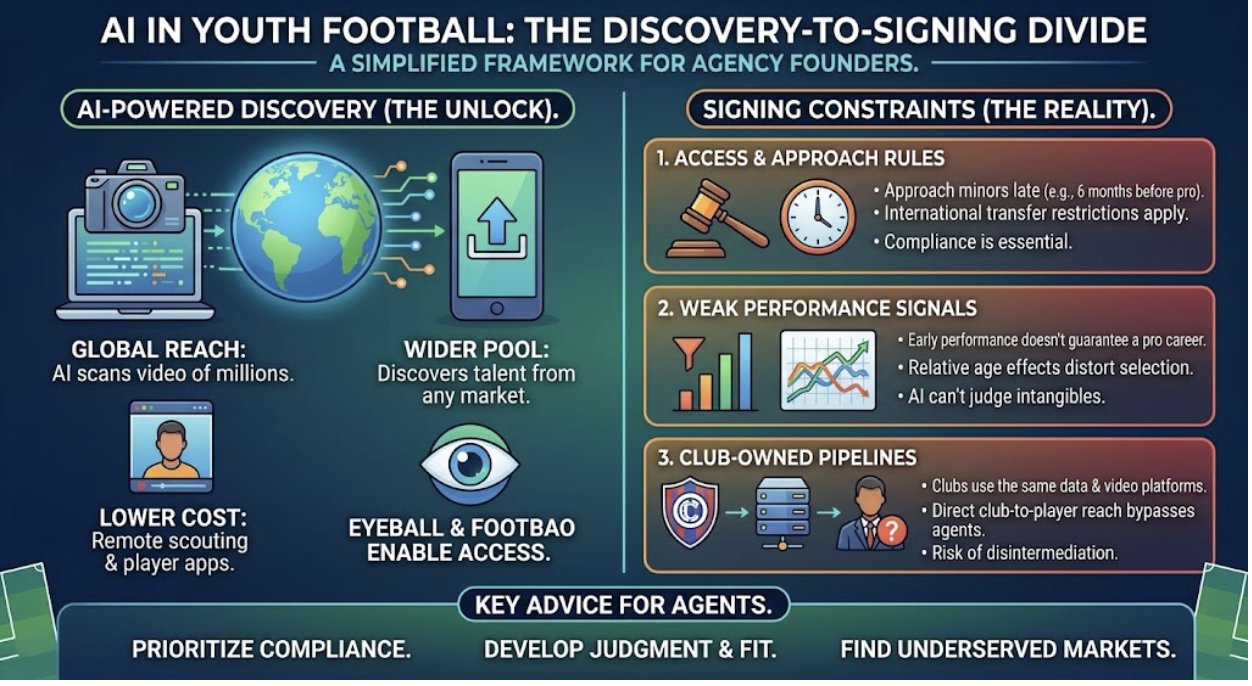
The claim, and what it actually covers
In June 2026, US Soccer's chief operating officer told a Fortune event that the federation could use AI to scout every match played by a US-eligible teenager anywhere in the world [1]. The figure attached to that ambition was between 50 million and 70 million teenagers, a pool defined by citizenship and parentage rather than birthplace [1]. The same remarks stressed that human scouts would still judge intangibles such as body language, so AI was framed as a way to surface candidates rather than to replace evaluation [1].
Two limits matter for an independent agency founder. The number describes one national-team pool, not the market an agency can lawfully approach or profitably represent. The statement is also an ambition about what video and AI make possible, not a measured result. This article therefore asks a narrower question: when the cost of watching youth football falls sharply, does the advantage in talent discovery move toward independent agency founders, or does it sit somewhere else?
The evidence supports a cautious answer. Discovery has become cheaper and wider, yet three constraints determine who converts a flagged teenager into a signed player. These are the rules on when an agent may approach a minor, the weak predictive value of early selection, and the fact that the data layer is sold to clubs as readily as to agents.
Overview: The Discovery-to-Signing Divide
What has become cheaper
The clearest change is the cost of capturing and scoring matches. Eyeball, a youth-football video scouting platform, said in a February 2025 interview that it captures about 2,000 games a week, and its co-founder presented clubs as the users who can now scout remotely [2]. These are company statements, and the public sources reviewed contain no independent audit of its coverage or accuracy.
A second model skips club partnerships and has players upload phone video. The Footbao app, used mostly in Brazil, has been used by around 120,000 players, according to AFP [3]. A Footbao executive told AFP that 14,000 to 15,000 of them have the potential to reach clubs or academies, which is a company estimate rather than a verified outcome [3]. One user, 18-year-old Veiga, was offered a short trial with the Italian club Lecce through the app, was noticed there by a scout, and now plays in the academy of Spezia [3]. The report does not say whether an agent was involved.
Agents have their own tools. The CRM and AI platform EnskAI, built on Hudl Wyscout data, is described in a March 2026 Hudl case study as used by more than 100 agencies in over 30 countries [4]. The case study centres on matching players to club requests and managing deal flow, not on finding unseen youth talent, and Hudl supplies the underlying data, so it is a vendor account. It still shows that data-driven tools for agents are sold off the shelf.
What the evidence does not show is a specific contribution from multimodal AI models. A 2022 academic benchmark concluded that tracking players in soccer video was far from solved under fast motion and heavy occlusion [5]. That work used single main-camera footage of professional league matches, which is probably better quality than a typical youth match, although the paper does not compare the two [5]. Eyeball's co-founder says its computer vision can already track players and the ball from non-broadcast cameras [2], but that is a company claim, and the public sources reviewed contain no independent evaluation of tracking or multimodal systems on amateur youth footage.
A June 2026 New York Times report on Brazilian trials says AI scouting platforms are already common in Europe [6]. That sentence is unsourced and does not say what those platforms do, so it shows only that Brazil's apps are not the first of their kind. What does look different in Brazil is who starts the process: players upload their own video or record drills, an app scores and ranks them, and one tryout in the report selected players aged 14 to 19 by their app scores [6]. Whether the larger change is reach into new markets, player self-submission, or lower cost is not settled by these sources, and none of them ties the change to multimodal models.
Why cheaper discovery does not settle the outcome
A lawful approach opens late, and the rule is applied unevenly
An agent can now identify a promising twelve-year-old cheaply, but the rules limit what happens next. The FIFA Football Agent Regulations bar agents from approaching a minor or the minor's guardian earlier than six months before the age at which the player may sign a first professional contract, and an approach needs the guardian's written consent [7]. Agents must also complete a designated course before representing minors [7]. A January 2024 law-firm review found no change to the strict minors rules when FIFA suspended other provisions [8]. National rules vary: the English FA, for example, applies its own age line tied to the academic year in which a minor turns 16 [8, 9].
The position is less settled in Brazil, where the Footbao app has most of its users [3]. An August 2026 legal commentary reports that FIFA did not itself suspend the minors article, but that a Rio de Janeiro court did suspend it in Brazil in an interim decision in December 2023 [10]. The same commentary says Brazil's Pelé Law declares agent contracts for athletes under 18 void, and that the reinstated 2022 national intermediary regulations bar any commission for under-18s [10]. It concludes that the combined position offers very little legal certainty for agents and families [10]. This is a single commentary that I could not tie to a peer-reviewed outlet, so a founder should check the Brazilian position with local counsel.
Practice also diverges from the written rule elsewhere. Danish national rules allow licensed agents to approach a player only six months before the player turns 15, yet a 2026 legal review notes that these restrictions are not always followed and that unofficial discussions often take place earlier [11]. Enforcement is visible but modest in England. The FA's sanctions list as of 18 August 2026 includes suspensions in cases involving approaches to minors and dealing with minors without additional authorisation, with the 2025 and 2026 entries typically carrying suspensions of three to six months and fines of £150 to £500 [9].
Moving a discovered player abroad is also restricted. International transfers are permitted in principle only from age 18, with exceptions such as parents relocating for reasons unrelated to football, moves within the EU or EEA for players aged 16 to 18, and a 50-kilometre border exception, all subject to prior approval [12].
Payment compounds the delay. FIFA's rules, as summarised by the Scottish FA, bar a commission for work on a minor unless the player is signing a professional contract [7], and Danish national rules say the same [11]. An agent who finds a promising fourteen-year-old therefore carries the cost of the relationship for years before any lawful fee arises.
The wider regulatory picture is unsettled, which is a risk in itself. On 16 July 2026 the EU Court of Justice ruled on FIFA's agent regulations without striking them down, and it returned the proportionality questions to the German court [13]. The judgment held that the fee cap is not, by itself, an automatic breach of competition law, but whether it passes the necessity and proportionality tests is left to the national court, and several provisions remain suspended worldwide [14]. FIFA has said it will consult agents on revisions as part of a wider transfer-system reform due on 1 January 2027 [14]. A founder should not build a financial model that depends on a particular commission level.
Early signals predict poorly
Even a perfect view of every match would not remove uncertainty about who will succeed. A 2024 study of 9,527 national players from five European countries reported low youth-to-senior transition rates, described the predictive value of early identification as weak, and found that relative age effects distort selection [15]. A Scottish academy study of 512 players found that physical and anthropometric data, even combined, predicted professional contracts about as well as random guessing, and that half of the successful players were born in the first quarter of the year [16]. A Spanish study found that selection becomes reliable only close to adulthood [17].
None of these studies tested AI systems. The New York Times report on Brazilian apps relays expert warnings that such metrics can favour taller or stronger athletes, and it notes that users can swap uploaded videos to raise their scores [6]. These are warnings, not measurements. It is plausible, as an inference, that a model trained to score current performance would inherit the same biases toward early-maturing and older-for-their-year players. If so, scanning more matches yields more candidates without yielding more certainty. The scarce skill becomes judging development over time, which is the part US Soccer itself assigns to human scouts [1].
The pipeline is sold to clubs too
The data sources behind AI discovery are built mainly for clubs. Eyeball's co-founder describes clubs as its users [2]. Santos announced a deal with Footbao in December to help identify young prospects [3]. The head of youth development at Palmeiras told AFP that he receives 30 to 40 videos a day and that the club did not then work with the pre-selection firms, which he called a new tool [3].
This pattern points to a risk of disintermediation. If clubs can reach the same long tail of players directly, the discovery function that once justified an agent's early involvement may shrink. The evidence for this is indirect, because no source reviewed measures how many signings originate from AI-flagged leads or who brokers them. The same New York Times report complicates the picture: platforms add athletes to databases where human agents can find them, or pitch athletes directly to clubs, and the Cuju app was created by a German sports agent [6]. Agents are therefore both users and competitors of these platforms. Cuju's marketing director also argued to AFP that club databases mostly contain players who have already been scouted [3], which supports the reading that open platforms reach players clubs miss. Both readings remain consistent with the evidence.
Economics reinforces the point. Researchers describing a career-recommendation project note that representing a young player with no clear transfer is risky for the agent and costly for the player, and that young players are not a reliable income source [18]. Cheaper discovery of more minors does not change that arithmetic.
Weighing the causes
The three causes do not carry equal weight. The access rules are the best evidenced and the most binding for players under 18, because they are written, enforced at least in some markets, and tied to the moment a fee can be earned, although their final shape is still being litigated and in Brazil their status is contested. The weak validity of early selection is well documented for conventional scouting but untested for AI systems, so it explains why more candidates do not mean better ones without proving that AI fails. Club-owned pipelines are the least directly evidenced, yet they are the cause most likely to change how the market is organized over several years.
Taken together, these causes mean that the scarce resource for an independent agency is not sight of the player. It is lawful, trusted access at the right moment, combined with the ability to place the player well. Discovery tools remove a cost, but they remove it for every competitor, including the clubs.
Where an advantage can still be built
The evidence leaves three places where an independent founder can plausibly differentiate. These are judgments drawn from the sources, not demonstrated outcomes.
Underserved markets: Upload apps reach players outside academy catchments [3], so a founder with local trust in such a market may meet players before club scouts do, within whatever approach rules apply there.
The approach window: Because lawful contact begins about six months before professional-contract age where the FIFA rule applies [7], advantage goes to the agent who arrives at that point with a compliant process, standing with clubs and academies, and a track record families can check.
Placement and fit: Tools that profile which clubs buy which kinds of players [4] help an agent convert a good prospect into a realistic move, which is where the fee is earned.
The argument weakens for older players. Selection becomes more reliable near adulthood [17], and the minors rules no longer bind at 18, so AI-assisted discovery of players aged 18 and over is likely to matter more to an agency than discovery of young teenagers. That prediction rests on the cited studies and rules, not on direct evidence from agencies.
What a founder should do with this
This section is my judgment from the sources above, not an evidenced result.
Treat compliance as a precondition rather than an edge. The minors course, guardian consent, and written agreements are open to every licensed agent, and the sanctions seen in England are modest [7, 9], so what separates agents is lawful access at the right moment and credible placement. Family relationships matter, but they have to be built through lawful channels. The FIFA rule covers approaches to a minor's guardian as well as to the minor [7], and the FA's list shows agents suspended for dealing with minors without authorisation [9], so cultivating a family early can itself be a breach. In practice that points toward clubs, academies, and other legitimate channels before the window, and toward direct family relationships after it opens. Whether a family that contacts an agent first, perhaps after finding a platform, counts as an approach is a legal question this review did not resolve.
Measuring conversion from flagged player to signed contract is more informative than counting players scanned. Discovery tools are widely available [2, 3, 4], so spending on coverage should stay proportionate, although this review found no pricing data and cannot say what coverage costs relative to other spending. Agencies should also assume that clubs will use the same data sources and design for a role in advising, placing, and negotiating rather than in finding alone.
This analysis applies to football systems governed by FIFA's agent and transfer rules. Where an agency works mainly with adult players, or in a jurisdiction with different rules for minors, the weighting shifts toward discovery.
Where the argument stops
Several questions would change the conclusion. No public source reviewed reports how many signings by independent agencies began with an AI-flagged lead. No independent evaluation was found of tracking or multimodal models on youth footage. The German court's proportionality ruling on fee caps and licensing, FIFA's decision about its suspended provisions, and the legal position on minors in Brazil are all unresolved. A favorable answer on any of these would strengthen the case for discovery tools, and an unfavorable one would strengthen the case for relationships and compliance.
References
Youth Sports Business Report (summarizing Nick Lichtenberg, Fortune, 2 June 2026). "U.S. Soccer Bets on AI to Scout 70 Million Eligible Teenagers Worldwide." 9 June 2026. https://youthsportsbusinessreport.com/u-s-soccer-bets-on-ai-to-scout-70-million-eligible-teenagers-worldwide/
Insider Sport. "Eyeball.Club: How computer vision is uncovering football talents globally" (interview with an Eyeball co-founder). 3 February 2025. https://insidersport.com/2025/02/03/eyeball-club-how-computer-vision-is-uncovering-football-talents-globally/
AFP via Malay Mail. "AI football apps help undiscovered Brazilian teenagers chase professional dreams." 2 June 2026. https://www.malaymail.com/amp/news/sports/2026/06/02/ai-football-apps-help-undiscovered-brazilian-teenagers-chase-professional-dreams/222292
Hudl. "How EnskAI Professionalizes Football Agencies with Wyscout." Hudl, 31 March 2026. https://www.hudl.com/blog/enskai-hudl-wyscout-case-study
Cioppa, A., Giancola, S., Deliège, A., et al. "SoccerNet-Tracking: Multiple Object Tracking Dataset and Benchmark in Soccer Videos." arXiv preprint, April 2022. https://arxiv.org/pdf/2204.06918v1
Ionova, Ana. "Could AI find Brazil's next Pelé?" The New York Times, 24 June 2026; republished by The Star (Malaysia), 26 June 2026. https://www.thestar.com.my/tech/tech-news/2026/06/26/could-ai-find-brazils-next-pel
Scottish FA. "Explanatory Note: FIFA Football Agent Regulations and Amendments to the Scottish FA Working with Intermediaries Regulations." 10 October 2023. https://www.scottishfa.co.uk/media/11029/ffar-intermediary-regs-explanatory-note.pdf
Lewis Silkin. "The new football agent regulations: where are we now?" 3 January 2024. https://www.lewissilkin.com/en/insights/the-new-football-agent-regulations-where-are-we-now
The Football Association. "Football Agent Suspensions and Sanctions, as of 18 August 2026." https://www.thefa.com/-/media/files/thefaportal/governance-docs/agents/football-agent-suspensions-and-sanctions---18-august-2026.ashx
Costa, João Marcello. "Legal Certainty in the Representation of Minors under FIFA and National Regulations." Executive Course in International Football Law, 2026 edition, August 2026. https://otvzraxebknbmngrciwm.supabase.co/storage/v1/object/public/landing-media/documents/academic-article-joao-marcello-costa-executive-course-2026-1786593445360.pdf
Chambers and Partners. "Sports Law 2026: Denmark, Trends and Developments." 2026. https://gpg-pdf.chambers.com/Sports-Law-2026/113/
"Transfer of a Minor Footballer: RSTP Article 19 and Its Exceptions." private.law wiki, 2026. https://wiki.private.law/en/fifa-minor-transfers
Gilson Gray. "CJEU Challenges FIFA Agent Rules." 17 July 2026. https://gilsongray.co.uk/blog/cjeu-challenges-fifa-agent-rules/
"The FIFA Football Agent Regulations Under Scrutiny By The Court Of Justice Of The European Union: What Lies Ahead?" Mondaq, 2026. https://www.mondaq.com/antitrust-eu-competition/1839880/the-fifa-football-agent-regulations-under-scrutiny-by-the-court-of-justice-of-the-european-union-what-lies-ahead
"Career trajectories, transition rates, and birthdate distributions: the rocky road from youth to senior level in men's European football." Frontiers in Sports and Active Living, 2024. https://www.frontiersin.org/articles/10.3389/fspor.2024.1420220/full
Craig, T. P. and Swinton, P. "Anthropometric and physical performance profiling does not predict professional contracts awarded in an elite Scottish soccer academy over a ten-year period." European Journal of Sport Science, 2021. https://rgu-repository.worktribe.com/output/958558
García Rubio, J., et al. "From Junior to Elite in Soccer: Exploring the Relative Age Effect and Talent Selection in Spanish Youth National Teams." Children, 2022. https://dehesa.unex.es/handle/10662/22183
Hamad Bin Khalifa University. "How Data Analytics Can Help Young Footballers Achieve Their Goal" ('Be a Star' project interview). 20 October 2022. https://www.hbku.edu.qa/en/news/CSE-SP-HDACHYF