AI Ad Generators Don’t Eliminate Creative Testing. They Change Where It Happens.
How AI is transforming ad production while making strategic testing, human judgment, and reliable performance measurement more important than ever.
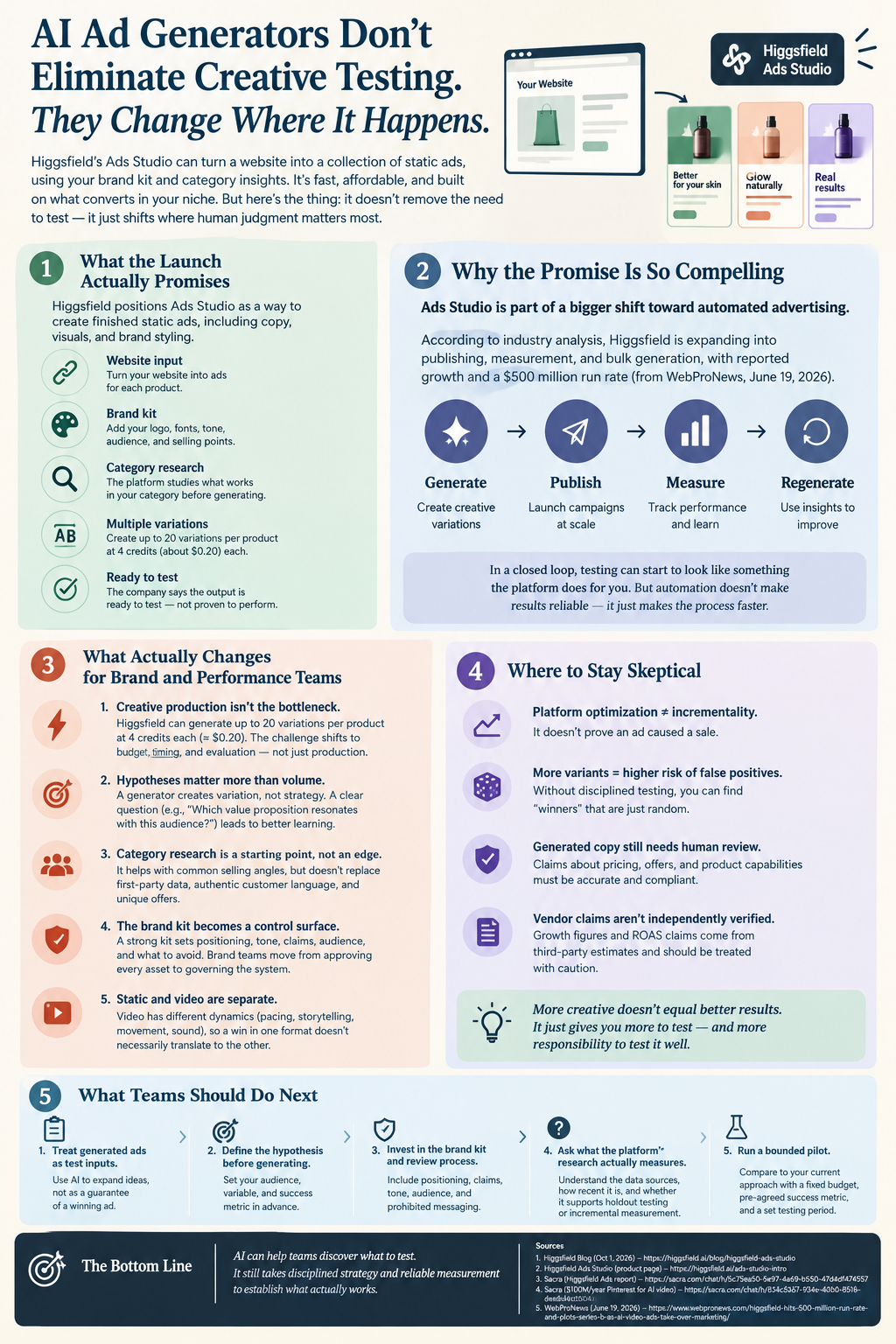
AI Ad Generators Don’t Eliminate Creative Testing. They Change Where It Happens.
On October 5, 2026, Higgsfield introduced Ads Studio, a tool designed to turn a website into a collection of static ads tailored to a brand’s products, audience, and market. The promise is compelling: generate creative informed by what works in your category, without starting from scratch. For brand and performance teams, it raises an obvious question: if AI can generate and refine ads at scale, how much creative testing still needs to happen?
The answer is more than some might expect. What changes is not the need for testing, but where human judgment becomes most valuable.
What the Launch Actually Promises
Higgsfield positions Ads Studio as a way to transform a website into finished static ads, complete with copy, visuals, and brand styling. Users can provide a brand kit containing elements such as logos, fonts, tone of voice, audience information, and key selling points. The platform then generates creative built around different selling angles, from product benefits to specific use cases and reasons to buy.
According to Higgsfield, the tool also examines how products are marketed within a given category before generating its output. The result, in the company’s framing, is creative that is ready to test.
That last distinction matters. Ready to test does not mean proven to perform. The suggestion that AI can eliminate testing is an interpretation of the product’s promise, not a demonstrated outcome. Early engagement with the launch signals market interest, but attention to a product announcement is not evidence that its ads generate better results. Public performance data establishing that advantage remains unavailable.
Why the Promise Is So Compelling
Ads Studio is part of a broader shift toward increasingly automated advertising workflows. Rather than simply helping marketers produce assets, AI platforms are moving toward systems that can generate creative, distribute campaigns, measure performance, and use those results to inform subsequent iterations.
Sacra’s analysis has pointed to Higgsfield’s potential expansion into publishing, measurement, and bulk generation. Third-party reporting has also highlighted the company’s rapid growth and ambitions for more automated advertising workflows. Together, these developments suggest a future in which creative production and campaign optimization become increasingly connected.
In that environment, testing can begin to look like a background process: generate variations, launch them, identify stronger performers, and produce new iterations.
But automating that cycle does not automatically make the conclusions reliable. A system can optimize toward a metric without establishing whether an ad caused a sale, whether the result will persist, or whether the creative strengthened the brand over time. Automation can accelerate the learning process, but only if the underlying measurement is sound.
What Actually Changes for Brand and Performance Teams
1. Creative production stops being the primary bottleneck.
When generating additional variations becomes fast and inexpensive, producing enough assets is less likely to constrain experimentation. The harder questions become how much budget to allocate, how long to run a test, how to distinguish meaningful differences from random fluctuations, and which variations deserve further investment. More creative is useful only when a team can evaluate it intelligently.
2. The quality of the hypothesis matters more than the number of variations.
A generator can produce dozens of headlines, visuals, and layouts. It cannot guarantee that those variations address the most important question facing a business.
A useful experiment might ask whether customers respond more strongly to convenience than affordability, or whether a specific product benefit matters more to first-time buyers than existing customers. Generating ten slightly different headlines without a clear rationale may produce activity without meaningful learning.
The opportunity is to shift from testing individual assets in isolation to testing the assumptions behind them.
3. Category research provides a starting point, not a competitive advantage.
Higgsfield’s promise of understanding what converts within a category is potentially valuable, but the underlying evidence matters. Category-level patterns can help marketers identify common selling angles and develop stronger initial concepts. They do not necessarily reveal what will work for a particular brand, audience, or offer.
As more competitors rely on similar tools and signals, their creative may begin to converge around the same familiar messages and formats. Differentiation will depend increasingly on first-party customer data, authentic customer language, distinctive positioning, and offers competitors cannot easily replicate.
4. The brand kit becomes a strategic control mechanism.
If AI systems are generating creative at scale, the quality of their inputs becomes increasingly consequential. A brand kit that contains only logos, fonts, and colors may produce visually consistent ads without capturing what makes the brand distinctive.
Teams will need to define more than appearance. They must communicate positioning, audience priorities, approved claims, tone of voice, and boundaries around what the system should never generate. Brand management consequently shifts from reviewing every individual asset toward establishing the rules, standards, and safeguards that govern the system.
5. Success in one format does not guarantee success in another.
Static and video creative operate under different conditions. A message that works in a static image may not translate effectively to a video, where pacing, storytelling, movement, and sound influence how audiences respond.
Because Higgsfield treats video generation as a separate product workflow, teams should evaluate those formats independently rather than assuming that a successful static concept will perform equally well in video.
Where Marketers Should Remain Skeptical
Greater automation does not remove the limitations of advertising measurement. It can make those limitations harder to notice.
Platform-reported performance, for example, is not the same as incrementality. An ad may receive credit for a conversion that would have happened anyway. Without an appropriate measurement design, teams cannot confidently determine how much additional business the campaign actually generated.
There is also a statistical risk in producing large numbers of creative variations. The more versions a team tests, the more likely it is to identify a seemingly successful result that reflects random variation rather than a genuine improvement. Clear hypotheses, sufficient sample sizes, and disciplined evaluation help reduce that risk.
Finally, generated creative still requires human oversight. Claims about pricing, discounts, product capabilities, and customer outcomes must be accurate and supportable. A visually compelling ad is not necessarily a compliant, credible, or effective one.
These concerns are especially important when evaluating vendor performance claims. Third-party estimates of Higgsfield’s growth are not independently verified evidence of advertising effectiveness, and claims about return on ad spend should be treated cautiously until supported by transparent, reproducible results.
What Teams Should Do Next
The practical response is not to avoid AI-generated creative. It is to adopt it without confusing production efficiency with proven performance.
Treat generated ads as experimental inputs. Use AI to expand the range of creative ideas, but do not assume that a polished output is a winning ad.
Define the learning objective before generating. Establish the audience, hypothesis, variable being tested, and success metric in advance. This makes it easier to distinguish useful experimentation from simply producing more assets.
Invest in the brand kit and review process. Document positioning, approved claims, customer insights, tone of voice, and prohibited messaging. Build human review into the workflow, especially for factual and regulated claims.
Ask what the platform’s research actually measures. When a vendor says its system studies what works in a category, ask which data sources inform those conclusions, how recent the data is, and whether the platform can distinguish correlation from causation. Ask, too, whether it supports holdout testing or other credible methods of measuring incremental impact.
Run a controlled pilot. Compare AI-generated creative against the team’s existing approach using a defined budget, a suitable testing period, and a success metric agreed upon before launch. Evaluate not only reported performance but also the reliability of the results and the cost of producing and reviewing the creative.
The Bottom Line
AI ad generators can make creative production faster, experimentation broader, and iteration less labor-intensive. Those are meaningful advantages. But they do not eliminate the need to decide what is worth testing, determine whether the evidence is credible, or understand why a campaign succeeds.
The real shift is from producing and approving individual ads to designing the system that generates, evaluates, and improves them.
AI can help teams discover what to test. It still takes disciplined strategy and reliable measurement to establish what actually works.
Sources
Higgsfield blog, “Introducing Higgsfield Ads Studio” (dated Oct 1, 2026), opened in full: https://higgsfield.ai/blog/higgsfield-ads-studio
It also lists A/B testing as an intended use case, with up to 20 variations per product at 4 credits (about $0.20) per ad. That supports the article’s point that variants are cheap, and I could add it.
Higgsfield Ads Studio product page, seen in a search snippet only: https://higgsfield.ai/ads-studio-intro
Sacra, Higgsfield Ads report, snippet only: https://sacra.com/chat/h/5c75ea50-5e97-4a69-b550-47d4df474557
Sacra, “$100M/year Pinterest for AI video” report, snippet only: https://sacra.com/chat/h/834c5267-934e-40b0-8518-dee8d46c8504/
WebProNews, “Higgsfield Hits $500 Million Run Rate…” (June 19, 2026), opened in full: https://www.webpronews.com/higgsfield-hits-500-million-run-rate-and-plots-series-b-as-ai-video-ads-take-over-marketing/